
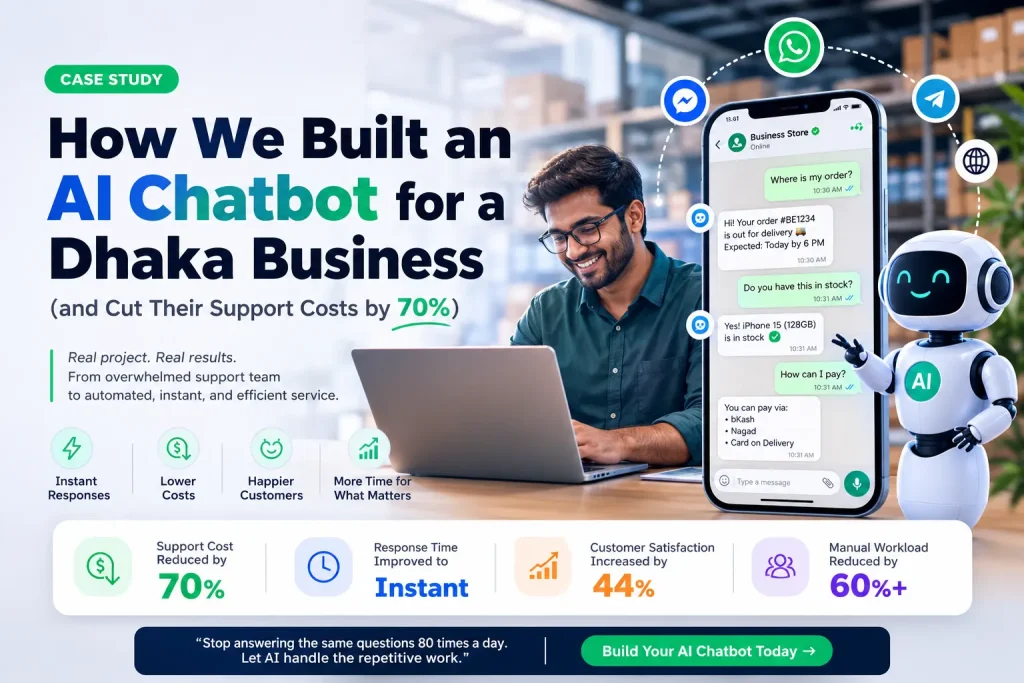
When people search for AI chatbot development Bangladesh, they usually are not looking for a flashy technology experiment.
They want practical results: faster customer service, fewer missed messages, less repetitive work and lower operating costs.
In October 2025, a business owner called me at 10 p.m. For privacy, I will refer to him as Rezaul.
Rezaul runs an online electronics store in Dhaka that processes approximately 200 orders during a typical month. When he called, he sounded exhausted.
“Feroz, my team is drowning,” he told me. “We’re receiving 60 to 80 customer messages every day through WhatsApp and Facebook. My two support employees cannot keep up. Orders are getting delayed because they are answering the same questions again and again.”
I asked him what customers were asking.
He laughed—a tired laugh—and listed the usual questions:
- Where is my order?
- Is this product in stock?
- What is your return policy?
- Can I pay with bKash?
- How long will delivery take?
It was the same small group of questions, repeated dozens of times every day.
That was when I realized Rezaul did not simply need more employees.
He needed a better system.
He needed automation.
AI Chatbot Development Bangladesh Case Study: The Real Problem
Rezaul initially believed that hiring another support employee would solve the problem.
But adding another person would have increased his monthly expenses without changing the repetitive nature of the work.
His customer-support operation looked like this:
- Two full-time employees handled WhatsApp and Facebook Messenger.
- The average response time was between four and six hours.
- Some messages did not receive a reply until the following day.
- Both employees regularly worked 10-hour shifts.
- Salaries and overtime cost approximately 35,000 BDT per month.
- Complaints about slow responses were increasing.
- The business had no dependable way to track unanswered conversations or the sales opportunities connected to them.
I asked Rezaul how many messages involved the same routine questions.
“Probably 70 out of 80,” he admitted.
Two employees were spending most of every day answering repetitive questions. Meanwhile, the smaller number of difficult problems that genuinely required human judgment remained stuck in the same queue.
That was not only a staffing problem.
It was a workflow problem—and a strong use case for AI chatbot development Bangladesh services.
What We Built for the Business
Rezaul did not want a basic chatbot that displayed “How can I help you?” and then sent customers through a frustrating menu.
He needed something that could work with his real business systems.
The solution needed to:
- Answer common customer questions
- Check product availability
- Retrieve order information
- Explain payment and delivery options
- Work through WhatsApp
- Support Bangla, English and Banglish
- Transfer complicated cases to a human
- Preserve the conversation during a human handoff
- Provide assistance outside normal business hours
At Business Express BD, we divided the project into four practical phases.
Phase 1: Understanding What Customers Actually Asked
Before building anything, I spent two days reviewing questions received by Rezaul’s team.
We did not rely only on what employees remembered. We examined real conversations and grouped the messages by topic.
The approximate breakdown looked like this:
- “Where is my order?” — 35%
- “Is this product in stock?” — 20%
- “How can I pay?” — 15%
- “What is your return policy?” — 12%
- “How long does delivery take?” — 10%
- “Do you offer EMI?” — 5%
- Questions requiring human judgment — 3%
This analysis showed that most customer conversations followed a predictable pattern.
Instead of trying to build an assistant capable of handling every possible situation, we focused first on the small number of questions responsible for most of the workload.
That is an important lesson for any AI chatbot development Bangladesh project: start with real customer behavior, not assumptions.
Phase 2: Building the Chatbot’s Knowledge
We built the chatbot using an OpenAI language model, but the language model was only one part of the solution.
A general AI model does not automatically know a company’s products, inventory, delivery zones, refund policies or customer orders.
We therefore connected the assistant to information specific to Rezaul’s business, including:
- Product catalogue
- Current inventory information
- Delivery timeframes by location
- Return and refund policies
- Available payment methods
- bKash and Nagad payment instructions
- Cash-on-delivery information
- Common product troubleshooting
- Order-status information
- Human-escalation rules
We also defined the assistant’s tone.
It needed to be friendly, clear and direct without becoming overly casual. It also needed to identify itself as an automated assistant and provide an easy way to request human support.
The chatbot could understand the meaning behind a customer’s message rather than relying only on an exact phrase.
For example, a customer might write:
“I ordered a phone yesterday. Where is it?”
The assistant could ask for the order number, check the connected order-management system and return the available delivery status.
If a customer asked whether a particular product was available, the chatbot could check current inventory instead of replying with a generic message.
If the system could not confidently answer, it transferred the conversation to an employee.
Phase 3: WhatsApp Chatbot Integration
WhatsApp integration was one of the most important parts of this AI chatbot development Bangladesh case study.
Rezaul’s customers were already using WhatsApp. Asking them to install another application, submit an email ticket or complete a long contact form would have created unnecessary friction.
We connected the chatbot to the company’s WhatsApp customer-support workflow so it could:
- Receive customer questions
- Answer recognized questions automatically
- Request an order number when necessary
- Retrieve available order information
- Provide payment instructions
- Provide delivery information
- Escalate unusual or sensitive problems
- Pass conversation history to a support employee
- Assist customers outside normal working hours
The integration uses the business-messaging infrastructure provided through Meta’s official WhatsApp Cloud API documentation.
We also added a web chatbot for customers visiting the store through a desktop or mobile browser.
The goal was not to force customers into a new communication channel.
The goal was to improve the channels they already preferred.
Phase 4: Testing and Improving the Responses
The first version was not perfect.
During the initial testing period, the chatbot handled many common questions correctly, but it sometimes misunderstood abbreviations, informal Bangla and mixed Banglish.
Rezaul’s team reviewed unsuccessful conversations and identified what had gone wrong.
We then improved:
- The chatbot’s instructions
- Knowledge-base content
- Response templates
- Order-status rules
- Escalation conditions
- Bangla and Banglish examples
- Product-name matching
- Test scenarios
The chatbot did not automatically learn from every conversation.
Its performance improved because people reviewed the mistakes and we deliberately updated its instructions, information and business rules.
Over the following weeks, the assistant became capable of handling most repetitive questions while sending uncertain or complicated cases to a person.
That is how reliable AI chatbot development Bangladesh solutions should operate.
A business chatbot should not invent an answer when it is uncertain. It should recognize its limits and transfer the customer to the appropriate employee.
The Results: Before and After
The client compared the month before implementation with the first full month after the system became operational.
The figures below came from the client’s internal customer-support records.
Daily Messages
Before:
Approximately 60 to 80 messages were handled manually by two employees.
After:
The same general volume was handled by the chatbot and one primary support employee.
Routine questions were answered automatically, while complicated requests were transferred to the employee.
Average Initial Response Time
Before:
Approximately five hours, with some customers waiting until the following day.
After:
Under 10 seconds for requests that could be answered automatically.
Response times for escalated human cases varied according to staff availability and the complexity of the problem.
Salary and Overtime Costs
Before:
Approximately 35,000 BDT per month.
After:
Approximately 15,000 BDT per month.
This represented a reduction of approximately 57% in direct salary and overtime costs.
Chatbot Hosting and Maintenance
The chatbot introduced an additional operating expense of approximately:
- 5,000 BDT per month
Total Monthly Support Operating Cost
Before:
- Staffing and overtime: 35,000 BDT
- Total: 35,000 BDT per month
After:
- Staffing: 15,000 BDT
- Chatbot hosting and maintenance: 5,000 BDT
- Total: 20,000 BDT per month
The business therefore reduced its total monthly customer-support operating cost by approximately 15,000 BDT.
That is a 43% reduction in total support operating costs.
The difference between the two percentages is important:
- Salary and overtime expenses fell by approximately 57%.
- Total operating costs, after including the chatbot, fell by approximately 43%.
Customer Satisfaction Improved
Before implementation, the business’s customer satisfaction rating was approximately:
- 3.2 out of 5
After implementation, it increased to:
- 4.6 out of 5
That represented an improvement of approximately 44%.
The improvement was not simply because the chatbot could answer quickly.
Customers also received:
- More consistent information
- Faster order-status responses
- Clearer payment instructions
- Assistance outside working hours
- Easier access to human support when necessary
Complaints About Slow Responses
Before implementation, the business recorded approximately 12 complaints about slow responses in a typical month.
During the comparison period after implementation, it did not record recurring complaints about slow initial responses.
This does not mean every customer problem was solved instantly.
It means customers received an immediate initial response, and requests requiring human assistance were identified and transferred more efficiently.
What Happened to the Support Employees?
The chatbot did not eliminate the need for people.
It changed how the team used its time.
One employee moved into returns, product-quality control and post-delivery support. These responsibilities required judgment and directly improved the customer experience.
The remaining support employee concentrated on:
- Unusual delivery problems
- Complicated product questions
- Refund disputes
- High-value customer requests
- Conversations requiring human judgment
The chatbot handled repetitive work.
The employees handled work where experience, empathy and decision-making mattered.
That is the role AI chatbot development Bangladesh should play in most small and medium businesses.
The Financial Impact and Break-Even Point
The business reduced total monthly support expenses by approximately 15,000 BDT.
The initial setup cost for this project was 50,000 BDT.
Based only on direct monthly savings:
50,000 BDT ÷ 15,000 BDT = approximately 3.3 months
The estimated break-even period was therefore a little over three months—not six weeks.
This calculation does not include potential additional revenue from:
- Faster responses
- Better customer retention
- Previously missed conversations
- Improved conversion rates
We did not include those possible benefits because the business did not have a reliable pre-project baseline for measuring them.
A credible case study should separate verified savings from possible additional benefits.
When AI Chatbot Development Bangladesh Makes Sense
I once thought AI chatbots were mainly for large companies with large technology budgets.
This project showed that small and medium businesses can benefit just as much.
Many growing businesses in Bangladesh already receive customer messages through WhatsApp, Facebook Messenger and their websites.
Customers repeatedly ask:
- Is this available?
- What is the price?
- Where is my order?
- How can I pay?
- When will it arrive?
- Can I return it?
- Are you open today?
When employees answer these questions manually dozens of times a day, the company is paying people to repeat information that could be supplied automatically.
The goal is not to remove the team.
The goal is to automate routine work so employees can concentrate on sales, customer relationships, product quality and difficult problems.
Which Businesses Can Benefit?
E-commerce Stores
An AI chatbot can help with:
- Order tracking
- Stock checks
- Payment instructions
- Return policies
- Delivery information
- Product recommendations
- Human-support escalation
Service Businesses
It can assist with:
- Appointment requests
- Pricing information
- Service availability
- Lead qualification
- Frequently asked questions
- Follow-up messages
Restaurants and Food Businesses
It can provide:
- Menu information
- Opening hours
- Delivery-zone details
- Reservation information
- Order-status updates
Real Estate Companies
It can answer questions about:
- Available properties
- Price ranges
- Property locations
- Viewing appointments
- Basic buyer or tenant requirements
Clinics and Healthcare Organizations
A carefully controlled administrative chatbot can assist with:
- Appointment scheduling
- Clinic hours
- Service information
- Doctor availability
- Locations and contact details
It should not diagnose patients, offer emergency advice or replace qualified medical professionals.
Schools and Training Centers
It can answer questions about:
- Course schedules
- Admission requirements
- Fees
- Available batches
- Class locations
- Registration procedures
How the AI Chatbot Works
A typical AI chatbot development Bangladesh solution contains four main components.
1. Language Understanding
A language model interprets natural customer messages.
It can recognize that:
- “Amar order koi?”
- “Where is my parcel?”
- “When will I receive my phone?”
may all be requests for order tracking.
2. A Business Knowledge Base
The knowledge base contains approved company information, including:
- Product details
- Policies
- Delivery rules
- Payment instructions
- Frequently asked questions
- Troubleshooting guides
3. Business-System Integrations
Depending on the project, a chatbot can connect with:
- Product databases
- Inventory systems
- Order-management systems
- Customer relationship management software
- Courier tracking systems
- Appointment calendars
- Internal APIs
These integrations allow the assistant to provide current business information instead of only generic responses.
Businesses that also need a new or improved website can review our WordPress web development service and selected project portfolio.
4. Human Handoff
A human-handoff system transfers difficult conversations to an employee.
The employee receives the previous conversation, so the customer does not have to explain the entire problem again.
A useful chatbot should always offer a clear path to human assistance.
Data Privacy and Security
Data privacy should be planned before an AI chatbot goes live.
The exact storage, access, retention and deletion rules depend on the model provider, hosting provider, connected platforms and project architecture.
OpenAI’s official API data-control documentation states that API data is not used to train or improve OpenAI models by default unless an organization explicitly opts in.
However, that does not remove the business’s responsibility to decide:
- What customer information is collected
- Where information is stored
- Who can access it
- How long it is retained
- How it can be deleted
- Which third-party services process it
- Whether sensitive information should be removed before processing
For projects involving financial, medical or other sensitive information, additional legal, privacy and security review may be necessary.
Frequently Asked Questions
How much does AI chatbot development Bangladesh cost?
A basic project similar to this case study may start from:
- 50,000 BDT as a one-time setup fee
- 5,000 BDT per month for hosting and maintenance
The final cost depends on:
- Number of supported channels
- Monthly message volume
- Required integrations
- Language requirements
- Security requirements
- Human-handoff workflow
- Reporting requirements
- Ongoing maintenance
A proper quotation should be based on the business’s actual workflow.
Will the chatbot sound robotic?
Not necessarily.
We configure the assistant around the business’s preferred tone, approved terminology and real customer questions.
The assistant should still identify itself as automated. The goal is not to deceive customers. The goal is to make automated support clear, fast and useful.
What happens when it does not know the answer?
It transfers the conversation to a human employee.
For example:
“That question needs assistance from one of our team members. I’ll pass this conversation to the appropriate person.”
The employee receives the previous messages, reducing repetition and frustration.
Can the chatbot communicate in Bangla?
Yes.
A chatbot can be configured to handle:
- Bangla
- English
- Mixed Bangla and English
- Informal Banglish
The final quality depends on the business terminology, available examples and testing process.
How long does development take?
A basic FAQ chatbot may take approximately two to three weeks.
A chatbot connected to inventory, order tracking or custom business software may take four to six weeks.
A more advanced retrieval system involving company documents and multiple integrations may take six to eight weeks or longer.
Can the same chatbot work on several platforms?
Depending on platform availability and approval requirements, the same business knowledge can support:
- Facebook Messenger
- A website chatbot
- Telegram
- Other supported messaging platforms
Each channel has its own technical and messaging requirements.
Can an AI chatbot run on our own server?
Some systems can be built using self-hosted language models.
However, not every commercial AI model can be installed on a private server.
For organizations requiring private-cloud or on-premises deployment, we evaluate a separate architecture using compatible models and infrastructure.
Is my business too small?
A chatbot may not be necessary when a company receives only a few customer messages each day.
It becomes worth evaluating when:
- The same questions appear repeatedly
- Customers wait too long for replies
- Employees spend hours copying the same answers
- Messages arrive outside business hours
- Important conversations are missed
- The business expects message volume to grow
The better question is not, “How big is my business?”
It is, “How much time and money are repetitive conversations costing my business?”
Request a Free AI Chatbot Audit
If you are considering AI chatbot development Bangladesh services, we offer a free 30-minute automation audit.
You show us:
- Where customers contact you
- Which questions they ask repeatedly
- How long responses currently take
- Which systems your team uses
- Which tasks consume the most time
We will identify:
- Which conversations can be automated
- Which conversations should remain with people
- What integrations would be needed
- A realistic implementation timeline
- Estimated setup and operating costs
You can also learn more about Business Express BD, review our recent work or contact our team to discuss your project.
No hard sell.
Just an honest assessment of whether AI automation makes operational and financial sense for your business.
Email: info@businessexpressbd.com